

There’s something about nighttime that can make a busy mind suddenly become even busier.
During the day, you have emails to answer, people to talk to, jobs to finish, and plenty of distractions competing for your attention. Then you finally get into bed – and suddenly your brain remembers everything.
The conversation you keep replaying. Tomorrow’s to-do list. Something you forgot to do. A problem you don’t know how to solve. A decision you’ve been putting off. Or perhaps a completely random thought that somehow turns into a 45-minute mental conversation.
If your mind tends to become more active as the day winds down, creating a calm night routine for overactive minds can help you make that transition from doing to resting.
And importantly, the aim isn’t to force your mind to switch off completely. That’s rarely realistic.
Instead, a good evening routine signals to your brain that the day is ending, helps you process thoughts before bed, and creates the conditions for easier relaxation and sleep.
In this post, you’ll discover:
- Why your mind can feel more active at night
- What makes a bedtime routine genuinely calming
- A simple calm night routine for overactive minds
- How a brain dump can help clear mental clutter
- Why worrying about sleep can actually make sleep harder
- Relaxation techniques to try before bed
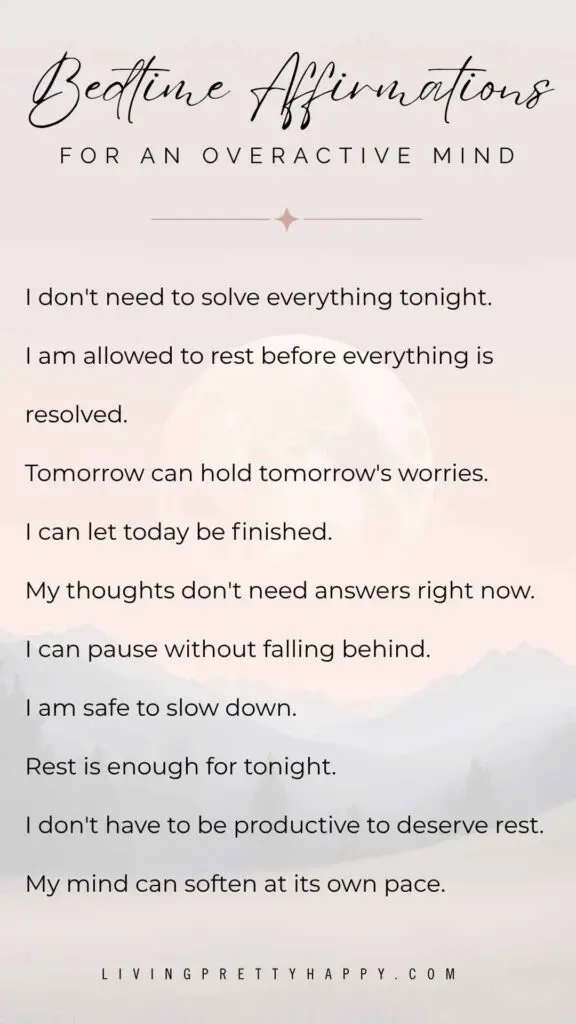
- Bedtime affirmations for racing thoughts
- What to do when your mind is still busy once you’re in bed
- When persistent sleep difficulties may need extra support
Why Does Your Mind Feel So Busy at Night?

If your thoughts seem louder at night, you’re certainly not alone.
One reason nighttime can feel particularly difficult is that the day’s distractions disappear. With fewer external demands competing for your attention, worries and unfinished thoughts can become much more noticeable. A psychological trap can also develop around sleep.
You get into bed thinking:
I really need to sleep tonight.
Then:
Why am I still awake?
Then:
I’m going to be exhausted tomorrow.
And before long, you’re monitoring every minute that you’re not asleep.
Unfortunately, becoming frustrated or anxious about not sleeping can create even more mental and physical arousal – precisely the opposite of what you need for sleep.
So rather than trying to force your brain to switch off, it can be much more helpful to gradually give it permission to slow down.
What Makes a Good Night Routine for an Overactive Mind?
A calming bedtime routine doesn’t need to involve a dozen steps, expensive products or a perfectly aesthetic bedroom.
In fact, simpler is often better.
A useful night routine should:
- create some separation between daytime and bedtime
- reduce stimulation
- give your brain somewhere to put unfinished thoughts
- encourage physical relaxation
- avoid turning sleep into another task you have to complete perfectly
- be realistic enough that you can actually repeat it
The NHS recommends establishing regular sleep and wake times and building relaxation into your evening routine. Reading, meditation, writing down worries and reducing electronic stimulation can all form part of a healthy wind-down routine.
With that in mind, here’s a simple routine you can adapt to your own evenings.
A Calm Night Routine for Overactive Minds
You don’t have to follow every step every night. Think of this as a menu, not a checklist. Choose the parts that genuinely help you feel more settled.
1. Give Yourself a Wind-Down Signal
Don’t wait until your head hits the pillow to suddenly decide it’s time to relax. Instead, choose a consistent time in the evening to start slowing down. This might be 30–60 minutes before bed. Dim the lights, put away work, change into comfortable clothes, make a caffeine-free drink or simply move into a quieter part of your home.
Over time, repeating the same sequence can help establish a psychological association between your evening routine and sleep. Consistent sleep and wake times are also recommended as part of good sleep hygiene.
Try telling yourself:
The day is winding down. I don’t need to solve everything tonight.
That distinction matters. You are not demanding that your brain stop thinking. You’re letting it know that problem-solving time is over for today.
2. Have a Brain Dump Before Bed
If your mind is constantly generating reminders, ideas and worries, give those thoughts somewhere else to go.
Take five minutes and write down:
What I’m thinking about
Anything that’s taking up mental space.
What needs my attention tomorrow
Write down practical tasks and reminders.
What can wait
This is particularly important. Not every problem needs solving tonight.
Writing down worries or creating a simple to-do list before bed can help move thoughts from your head onto paper. The NHS specifically recommends writing down worries and setting aside a designated time to worry as a way to manage racing thoughts.
You could even finish with:
Tonight, I am allowed to leave this here.
Then close the notebook.
The goal isn’t to solve your entire life in five minutes. It’s simply to stop your brain having to keep reminding you of everything.
Want a little help getting everything out of your head?
If you find that your thoughts, reminders and unfinished tasks tend to swirl around your mind at bedtime, a dedicated brain dump printable can make this process much easier.
I’ve created a Brain Dump Printable PDF & Overwhelm Reset to give you a simple place to unload what’s taking up mental space, rather than carrying it all around in your head.
You can use it whenever your mind feels full — including as part of your evening routine when you want to clear some mental clutter before bed.
The aim isn’t to organise your entire life before bedtime. It’s simply to get the thoughts out of your head and onto the page, so you can give yourself permission to come back to them tomorrow.
3. Create a ‘Worry Window’
For some people, a traditional brain dump isn’t quite enough.
If you find yourself repeatedly thinking through the same problem at bedtime, try moving your worrying earlier. Set aside 10–15 minutes during the evening to deliberately think about what’s bothering you.
Write down:
- What am I worried about?
- Is there anything I can actually do about this?
- If yes, what’s one small next step?
- If no, can I consciously leave it until tomorrow?
This is sometimes called worry time, and the NHS suggests it as a strategy for preventing worries from taking over when you’re trying to sleep.
It can feel strange at first to schedule time for worrying. But the idea isn’t to encourage worry. It’s to create a boundary around it.
4. Reduce Stimulation Before Bed

If your brain is already running at full speed, feeding it another hour of scrolling, news, work emails, or emotionally charged conversations probably won’t help it slow down. Consider creating a screen-light period before bed.
You could:
- put your phone on Do Not Disturb
- stop checking work messages
- move social media scrolling out of your bedroom
- switch from stimulating television to something quieter
- read a book
- listen to relaxing music or an audiobook
- take a warm bath or shower
The NHS recommends building relaxation time into your evening and reducing electronic-device use before bed.
And remember: you don’t have to eliminate screens completely if that makes your routine unrealistic.
The aim is to reduce stimulation, not create another thing to feel guilty about.
5. Help Your Body Relax
An overactive mind isn’t always the only problem. Sometimes your body is still carrying the day’s tension too.
Try spending five minutes deliberately relaxing your body.
You could practise:
Slow breathing
Take a comfortable breath in and make your exhale slightly longer.
Don’t worry about achieving a perfect breathing pattern. Simply focus your attention on the sensation of breathing.
Progressive muscle relaxation
Starting with your feet and working upwards, gently tense and then release different muscle groups.
Gentle stretching
A few slow stretches can help shift your attention away from thoughts and towards physical sensations.
Relaxation techniques such as breathing exercises and progressive muscle relaxation are commonly used to reduce physical and cognitive arousal associated with sleep difficulties.
6. Try a ‘Boring’ Bedtime Activity
Sometimes the best thing you can do for an overactive mind is give it something low-stimulation to focus on.
Read a familiar book.
Listen to a quiet audiobook.
Try a simple colouring activity.
Put on soft background sounds.
Do a few repetitive stretches.
The key is to avoid choosing something so interesting that your brain becomes more alert. Your evening doesn’t need to be productive. In fact, that may be exactly the point.
7. Make Your Bedroom a Cue for Rest

Your environment can reinforce your routine.
Aim for a bedroom that feels:
Cool. Dark. Quiet. Comfortable.
Of course, there’s no single perfect bedroom temperature or setup for everyone. What matters is finding an environment that feels conducive to sleep for you. The NHS recommends a quiet, dark and cool sleeping environment as part of good sleep habits.
You might also want to:
- put your phone somewhere you can’t automatically reach for it
- turn your clock away if watching the time makes you anxious
- keep a notebook beside the bed for thoughts that genuinely need recording
- reduce unnecessary noise and light
That last point can be particularly useful if you’re prone to waking up and immediately checking the time.
8. Don’t Make Sleep Another Performance Goal
This might be one of the most important parts of a calm night routine for overactive minds.
You don’t have to make yourself sleep.
The more pressure you put on yourself to fall asleep immediately, the more frustrating being awake can become.
Instead of:
I have to fall asleep now.
Try:
I don’t need to force sleep. I can simply rest.
And if you stay awake and become increasingly frustrated, don’t feel you have to stay in bed battling your thoughts. Sleep-medicine guidance recommends getting out of bed if you can’t sleep, doing something quiet and relaxing, and returning to bed when you feel sleepy again.
The aim is to prevent your bed becoming associated with wakefulness, frustration and worry.
9. End Your Routine With an Affirmation
This is where a few simple bedtime affirmations can become a lovely final part of your routine.
Rather than using affirmations to convince yourself that everything is perfect, choose words that feel believable, grounding and reassuring.
For example:
I don’t need to figure everything out tonight.
Tomorrow will have its own time and space.
I am allowed to rest without having everything resolved.
My thoughts can be here without needing my attention.
I can let today be finished.
I don’t have to solve tomorrow tonight.
Rest is enough for this moment.
I can release what I cannot change tonight.
My mind can slow down at its own pace.
I am safe to pause.
A 10-Minute Bedtime Reset for Racing Thoughts

If you don’t want a complicated evening routine, try this instead.
Minute 1–3: Brain Dump
Write down everything your brain keeps reminding you about.
Minute 4–5: Tomorrow List
Write down the three most important things to remember tomorrow.
Minute 6–7: Release
Ask:
Is there anything else I can realistically do about these thoughts tonight?
If the answer is no, let that be enough.
Minute 8–9: Breathe
Slow your breathing and allow your shoulders, jaw and hands to relax.
Minute 10: Affirmation
Choose one:
I don’t need to solve everything tonight.
Then turn the light off.
No checking your phone.
No checking the time.
No mentally reviewing your entire life.
Just rest.
A handy tool for your bedtime brain dump

If you like the idea of writing everything down but don’t want to start with a blank sheet of paper, you can use my Brain Dump Printable PDF & Overwhelm Reset as part of this 10-minute reset.
It’s designed to give those thoughts somewhere to land, helping you create a little more mental space before you move into the rest of your evening.
You can keep a copy somewhere easily accessible and use it whenever your mind feels overloaded — not just at bedtime.
What If Your Mind Is Still Racing Once You’re in Bed?
Sometimes you can do everything “right” and still find yourself lying awake.
That’s okay.
One restless night doesn’t mean your routine isn’t working. If you’re awake and becoming increasingly frustrated, try shifting the goal from falling asleep to resting.
You could:
- focus on your breathing
- listen to something quiet
- practise progressive muscle relaxation
- mentally scan your body from head to toe
- repeat a calming affirmation
- get out of bed for a quiet activity if you’re becoming frustrated or clearly unable to sleep
Try not to check the clock repeatedly. Watching the minutes disappear can increase anxiety about how much sleep you have left, creating a cycle of worry that makes relaxation harder.
And remember: rest doesn’t have to be perfect to be worthwhile.
What NOT to Do When You Have an Overactive Mind at Night
It’s easy to fall into habits that accidentally make nighttime overthinking worse.
Try to avoid:
❌ Trying to solve every problem at bedtime
Some problems genuinely need sleep, time and a fresh perspective.
❌ Checking the clock repeatedly
If seeing the time increases your anxiety, turn the clock away.
❌ Scrolling through stressful content
News, social media arguments and emotionally stimulating content can make it harder to transition into sleep.
❌ Turning your bedtime routine into another productivity project
You don’t need the perfect evening routine.
❌ Getting frustrated with yourself for being awake
Your brain isn’t failing because it hasn’t switched off on command.
❌ Staying in bed for hours feeling increasingly tense
If you’re wide awake and becoming frustrated, getting up for a quiet activity can be more helpful than continuing to battle with sleep.
The Best Night Routine Is the One You Can Actually Repeat
It’s tempting to create an elaborate bedtime routine involving meditation, journaling, stretching, reading, skincare, breathwork and a perfectly organised bedroom.
But if the routine takes an hour and a half, requires twelve products and feels like another item on your to-do list, it’s unlikely to help an already overactive mind.
Start small.
Perhaps your routine is simply:
10-minute brain dump → phone away → warm drink → five minutes of breathing → affirmation → bed.
That’s enough.
You can build from there if you want to. The most useful routine is one that feels achievable enough to become familiar.

A Gentle Reminder for Busy Minds
If your mind feels particularly loud at night, you may be tempted to think that you need to find the perfect technique to make it stop.
You don’t.
Thoughts are allowed to come and go.
You don’t have to answer every thought.
You don’t have to solve every problem.
And you don’t have to have tomorrow figured out before you go to sleep tonight.
Sometimes a calm night routine for overactive minds isn’t about achieving a completely empty mind. It’s about creating enough space between you and your thoughts that they no longer need your immediate attention.
So tonight, try closing the notebook, putting your phone down and reminding yourself:
Nothing else needs to be solved right now.
Tomorrow can wait.
For tonight, you can rest.
When Should You Seek Help for Ongoing Sleep Problems?
Occasional restless nights are normal, particularly during stressful periods or when life feels particularly busy.
However, if difficulties falling or staying asleep persist, regularly affect your daytime life, or cause significant distress, it’s worth speaking to your GP or another healthcare professional.
Persistent insomnia can have many possible causes, and evidence-based treatments such as cognitive behavioural therapy for insomnia (CBT-I) may be appropriate for some people.
A bedtime routine can support healthier sleep habits, but it isn’t a substitute for professional help when sleep problems are ongoing.
Final Thoughts
A busy mind doesn’t necessarily need to be silenced. Sometimes it simply needs a little time, structure and reassurance.
A consistent calm night routine for overactive minds can help you create a clearer boundary between the demands of the day and the rest your body and brain need at night.
Start with one or two changes. Write down what’s on your mind. Give tomorrow’s worries somewhere to go.
Dim the stimulation.
Breathe.
Let go of the expectation that you have to fall asleep immediately.
And most importantly, remind yourself that you are allowed to stop for the day, even when everything isn’t finished.
You can pick things up again tomorrow.
Tonight, you can rest.
Bedtime Affirmations for an Overactive Mind
I hope you’ve found my calm night routine for overactive minds helpful. Do you do any of these suggestions already? Do you have any of your own to share? Whatever you’d like to say or ask, please do. I love to help and I’m always happy to hear from you.
Sources & Further Reading
- NHS Every Mind Matters — sleep and sleep hygiene guidance
- NHS Every Mind Matters — tackling worries and using designated worry time
- Sleep Foundation — building a better bedtime routine
- American Academy of Sleep Medicine — behavioural and cognitive treatments for insomnia
- University College London Hospitals NHS Foundation Trust — sleep hygiene and relaxation techniques
- Oxford Health NHS Foundation Trust — managing worry about sleep
This article is intended for general wellbeing and educational purposes and isn’t a substitute for individual medical advice.