

My friend Lauren is a wonderfully inspiring person. She looks at life from a ‘what could go right’ perspective. She has this brilliant ability to tune in to her encouraging thoughts & feelings and allow them to spur her on. Inevitably, things do seem to work out well for her, most of the time.
Lauren is an optimist.
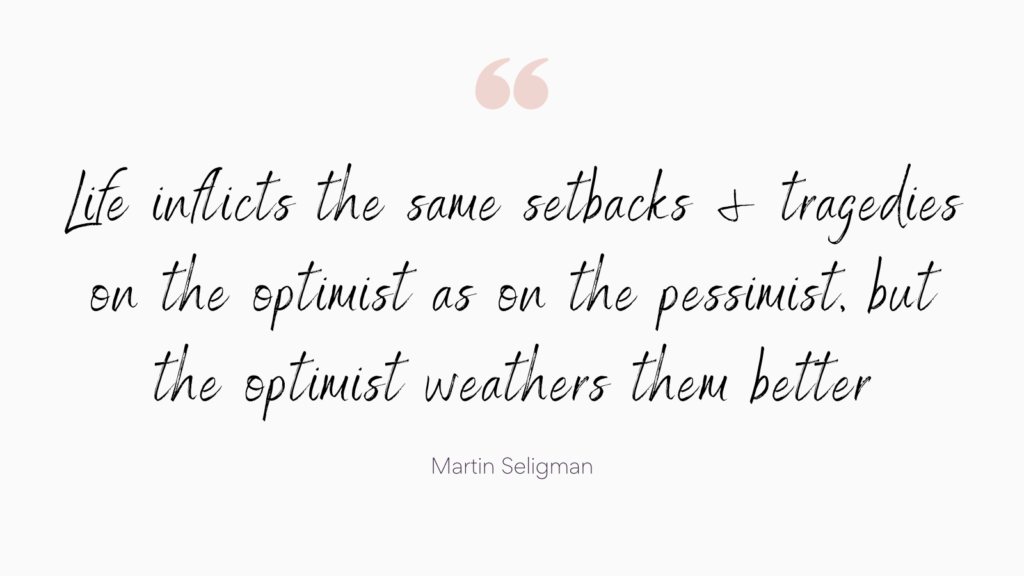
Optimists are more hopeful; they believe in positive outcomes. They’re not immune from anything; they too experience all the emotions – good & bad – along the way; but they view setbacks as challenges to overcome. They keep the belief that all can work out well.
Why should we be optimistic?
Numerous studies have highlighted the benefits of being optimistic. People worldwide have reported perceptions of better physical & emotional health.
As well as contributing towards better health, optimism can make you more courageous, more motivated, less stressed and more likely to take better care of yourself. Ultimately, being more optimistic can lead to a more enjoyable life.
Good to know: Everyone needs balance – even optimists – a combination of optimism and realistic thinking is the winning formula to help you navigate life better. For more advice on this, I recommend you read: Why a bit of negative thinking is good for you.
Can pessimists become optimists? Or are we just born this way?
Pessimism is a habit— a habit that can be unlearnt. Optimism is also a habit – can you guess where I’m going with this? I, for several years, was a pessimist. Spoiler Alert: It wasn’t much fun.
As I learnt about growth mindset & positive thought processes (and experienced their benefits), I made an effort to adopt optimism as a habit. With a bit of effort & practice, it can be done. You can be more ‘Lauren’ too.
6 Effective Ways to Be More Optimistic:
#01 Your Best Possible Self Activity
The Best Possible Self Activity is fun and helps to get your mind focused more positively & productively. As part of a 2012 study, it proved a viable intervention for increasing optimism.
Best Possible Self Activity:
Spend 10 minutes writing down your answer to the question below. Be as creative & imaginative as you want and stay authentic. Use whatever writing style works best for you, and give as much detail as you like. However, you must make sure what you write is attainable in the real world (sorry folks, that means invisibility cloaks are off the table)
Fast forward to 12 months from now. You are your best possible self. Think about the areas of your life that matter the most to you (e.g. social, career, health). Imagine that everything has gone as well as it possibly could. What does life look like? What are all the positive changes that have happened?
At the end of the 10 minutes, do this:
Now, write down a goal (or goals) you think might help you achieve what you just described. Sometimes lofty goals seem overwhelming, but each journey starts with a single step. Think about those baby steps towards your big goals.
“A baby step can be as simple as proactively seeking information you need or talking to someone who may be able to guide you. Defining the next baby step you need to take to get a little closer towards your goal is a great way to get going with the journey without worrying too much about the length of the road”
Sonja Lyubomirsky
Top Tip: Make it easier on yourself by splitting the different areas of your life into separate BPS writing activities covering one area each week. For example, concentrate on career one week, then health the next and so on.
#02 Apply Perspective

It’s all too easy to focus on the negative. Growing in optimism requires you to zoom out, take in the whole picture, and challenge negative self-talk.
Renowned positive psychologist Martin Seligman highlighted three thinking traps we tend to fall into:
Personalisation – assuming that the problem is yourself
Permanence – thinking that the problem will last forever
Pervasiveness – thinking that a bad situation applies across all areas of your life
When we zoom out and apply perspective, we can help ourselves see:
- The blame doesn’t fall entirely on us; outside factors need to be considered too.
- Setbacks are often temporary; we can adapt.
- The likelihood is the problem will only impact one area, not multiple.
For example, imagine you apply for but don’t get a job. You may think: I’m not good enough, there is something wrong with me. I will never get a job. I’m failing at this and at everything I do. Instead, work on altering your thinking to: It wasn’t a good fit, I will find a job soon, this is a work thing – I have plenty of successes in other areas of my life.
#03 Practice gratitude
Gratitude is great for increasing optimism. Focusing on what you have to be grateful for and acknowledging your successes (no matter how small) demonstrates how things can – and do – go well for you.
For my top tips on practising gratitude read: 3 Ways to Use Gratitude to Increase Your Well-Being
#04 Focus on what you can control
There are plenty of things in life beyond our control. However, there are things we do have control over. OK, I can’t guarantee a lottery win, but I can at least buy a ticket. Focusing on what we can control is empowering and certainly puts you on the right path towards a more positive outcome.
I personally find the exercise below helpful for switching focus to what I can control. Feel free to print it out and give it a go yourself.
#05 Look at your network
Spending time in the company of an optimist leaves me feeling more positive and buoyed. Equally, spending time in the company of a pessimist leaves me drained. There is nothing wrong – in fact, it’s helpful – having friends in your network who help you keep your feet on the realistic ground. However, stack the optimism odds more in your favour by adding more optimistic friends.
#06 Limit the news
Whilst it’s important to know what’s going on in the world, don’t over-consume negative news – it rarely helps. The big news networks thrive on dishing out doom and gloom. Try to balance it out with more positive news stories. I recommend sites such as the Positive News Network or the Happy Newspaper.
Go forth and optimistically prosper!
The more you practice optimism, the more optimistic you’ll become. Yes, still keep the realness there too, but the more hopeful you can be for more favourable outcomes, the more you’ll enhance how happy you feel.
RELATED: How to Be More Positive
Source references:
https://positivepsychology.com/learned-optimism/
https://pubmed.ncbi.nlm.nih.gov/12585811/
https://www.nbcnews.com/better/health/how-train-your-brain-be-more-optimistic-ncna795231
https://www.sciencedirect.com/science/article/abs/pii/S0005791611000358?via%3Dihub
https://link.springer.com/article/10.1007/s10902-016-9824-z
https://positivepsychlopedia.com/year-of-happy/the-benefits-of-optimism/
How easy do you find it to be optimistic? Have you tried any of these suggestions before? Do you have any top optimism tips to add? Whatever you’d like to say – or ask! – please do. Just leave me a comment in the box below. I’m happy to help and I always love to hear from you.
ADVERTISEMENT:




I don’t think I’ve ever read an article or blog post about being more optimistic, so I found this really interesting. Thanks Alex! It has really made me think about what steps I need to take to become more optimistic and I’ll definitely have a go at your practical exercises which I’m sure will help with this. This post has made me feel optimistic about becoming an optimist. 🙂
Gemma x
He He! Thanks so much Gemma, I’m glad you found it helpful xx