When life gets challenging, it’s often the simple things which can help us manage and boost our happiness level.
There are many activities in which we are increasingly understanding the therapeutic nature of to help improve our well-being. Whether that’s a walk in nature, mindful colouring, crafting, exercising, meditating, journaling and – one we’ll be focusing on today – mindful bread baking.
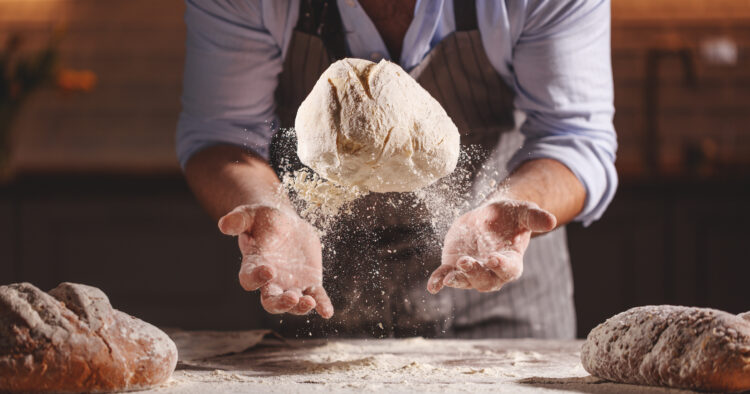
From kneading dough to taking a freshly-baked loaf out of a hot oven, bread-making is a mindful experience and a restorative craft that can help us all.
RELATED: A Guide to Mindful Baking
Disclosure: This post contains affiliate links. I may receive a commission if you visit a link and buy something on my recommendation. Purchasing via an affiliate link is at no extra cost to you, but does contribute towards the running costs of this site. All opinions expressed within are my own. For more details see my disclaimer here.
Today, I’m delighted to welcome Pauline Beaumont, a psychological therapist, mum of 6, passionate baker & the author of Bread Therapy: The Mindful Art of Baking Bread. In her new book, Pauline describes all the ways in which making bread can contribute to our mental well-being (including some helpful recipes) and she’s kindly sharing some of her insights into this mindful activity with us now.

So Pauline, what led you to baking bread?
“About 15 years ago I was working full time in arts management, I had young children and I was, looking back, quite stressed, living too much in my head. I recognised a strong urge in myself to make something real, to make something with my hands and I alighted on making bread.
As soon as I started baking my own bread I loved it and I felt like I had come home to something that felt just right. It forced me to slow down, it was soothing and grounding and gave me such a simple sense of satisfaction, making something from start to finish which I could then give to other people, especially my family.
Nine years ago, I was made redundant and had the opportunity to think properly about what I wanted to do next. I decided to make a radical change and went back to university where I did some post-graduate training in psychological therapy. I had been a CEO of a small, publicly funded, cultural body; now I was the most junior of mental health staff, but I loved it and have not regretted the change of career for a second.
I’ve worked as a therapist now for 7 years and making bread has continued to be my companion, a welcome pause in my weekly schedule.”

RELATED: 5 Useful Ways Mindfulness Helps in Our Daily Lives
That’s quite a journey! I’m interested to know what you believe the benefits of mindful baking are? How can baking bread help our well-being?
“Baking bread can help us at a number of different levels.
If we make our own bread then it is likely to be more nourishing than factory-made bread, especially if it is made with wholemeal flour and particularly if it is sourdough. Wholemeal, sourdough bread, made with a rich mixture of grains and seeds is an ideal pre-biotic, that is, it feeds our gut micro-biome which then supports both our mental and physical health.
Eating well is part of good self-care and giving ourselves nutritious, real food also gives us the message that we are worth looking after well.
Making bread gives us the opportunity to practise mindfulness which both helps us to slow down and become calmer but also can teach us to be able to direct and better manage our attention. This, in turn, can be helpful in managing our mood and anxiety levels.

There are so many different sorts of bread to make and experimentation with ingredients possible that making bread can be a genuinely creative activity. There is something profoundly satisfying about the creative act of making something from scratch with your own hands.
There is always something new to learn in bread making and being creative and going on learning are both things that we know benefit our mental health.
Making our own, beautiful, hand-crafted nourishing loaves can be an expression of our values, choosing to make bread by hand from local ingredients rather than buying mass-produced loaves made from refined flour, full of additives.
Bread making connects us with others. It links us with our ancestors and with people all over the globe. It directly connects us to the people we share our bread with and can be an expression of nurture and love.
There are important life lessons to be learnt from making bread too.”
Wow! There are a lot of positive benefits to be realised. Can you expand on the life lessons you’ve mentioned?
“Yes. One of them concerns imperfection and the importance of learning to accept it. No matter how long you have been baking bread there are still things that can go wrong.
I’ve been baking bread for years and I will still have the odd loaf that is raw in the middle or underproved or a bit burnt. In learning to accept imperfection and things not turning out as expected in every day, small things like imperfect loaves we can practice accepting flaws and imperfections in ourselves and in the imperfect lives we all lead.
Our imperfect loaves can be a reminder that it is an existential reality that we are all flawed, we all make mistakes, do things we regret and that this is normal, it is part of being human. We can’t go back and start again so we all need to find a way to accept our imperfections, keep going anyway and show ourselves the sort of compassion we are usually much better at showing other people.
Perfectionism, trying too hard to prove ourselves, is a common cause of anxiety and low mood. Self-compassion and self-acceptance are both powerful tools to counter perfectionism and our imperfect loaves can help us to develop them.
I think being a bread maker has helped me to learn this important life lesson, to accept myself as I am.
Paradoxically it has also taught me that transformation and change is always possible too. It is never too late for any of us to learn to understand ourselves better and to let go of patterns of thinking and behaving that are not serving us well.”
“I think being a bread maker has helped me to learn this important life lesson, to accept myself as I am. “
Pauline Beaumont
I love this reflection. So, who is bread therapy for then? Do you have to be an experienced baker or can you be a complete novice?
“In writing Bread Therapy I have had in mind both the novice baker who I hope will be encouraged to bake their own bread for the first time and more seasoned bread makers who may be encouraged to see the practice of breadmaking in a new light, to realise that there are depths to bread making that can contribute to their wellbeing.
The life lessons and insights in the book will be helpful to people who want to understand themselves better even if they don’t choose to bake bread but I very much hope that they will give it a try.
It might seem that fitting one more thing into a busy schedule would actually add to our stress if we are juggling work and caring responsibilities, but time spent in activities that are soothing and grounding can actually help us to get through the rest of the things we have to deal with.
Making bread forces us to slow down and connect with our own physicality; it might not always feel easy to find the time but like any respite or downtime, it will recharge our batteries, something we all need.”
Sounds good! How do we get started with mindful bread baking? Is it expensive?
“Making bread can be a cheap and simple endeavour. While it is great if you can find and afford organic, stoneground flour, there is nothing wrong with bread flour from a supermarket. A mixing bowl and a baking tin or sheet are the basic requirements and you are off.
Bread Therapy has simple recipes and clear instructions for making the quickest loaf – soda bread (mixed and ready to eat in less than an hour), and also sourdough from scratch which is a much longer process but is incredibly rewarding and produces particularly delicious and healthy breads.”
“A mixing bowl and a baking tin or sheet are the basic requirements and you are off.”
Pauline Beaumont
Thanks Pauline, this has been really insightful and I’m looking forward to giving it a try myself! But before you go, are there any top tips you can share with us here?
“The main thing is to have a go, don’t be afraid that it won’t turn out well, it doesn’t matter. Focus on your senses, slow down, enjoy the dough in your hands, smell the crust as it browns in the oven, enjoy the lovely feeling of giving your family and friends bread that you have baked with your own hands and with love.”
For more information on Pauline’s book – Bread Therapy: The Mindful Art of Baking Bread click here
Happy mindful baking everyone!

Pauline Beaumont has a degree in Psychology and Philosophy, a post-graduate certificate in Low Intensity Psychological Therapy and a Diploma in Group Work Practice. She works as a student counsellor at Newcastle University, supporting students who are struggling with a wide range of mental health problems. She has found that the physical and meditative nature of making and providing bread has helped her foster the self-acceptance that she works to help her clients reach. As a mother of six, baking bread is both an expression of love and a way of staying calm amidst the occasional of family life.
You might also like to read: Colour Me Happy – A Complete Guide to Mindful Colouring

Are you a fan of baking? Have you ever baked bread before? Did you realise the potential therapeutic benefits of mindful baking? Is this something you would like to try for yourself? Whatever you would like to say – or ask – just get in touch via the comment box below. I am happy to help and I always love to hear from you!
ADVERTISEMENT:

This is so interesting and I feel like it touches upon this central truth that many of us realize one way or another – that simple activities (often away from screens) can really be therapeutic and meditative. Baking (or cooking) is def one way because of how it keeps you occupied in the present moment and how it nourishes the body, but things like putting on makeup, painting…. even pumpkin carving can offer similar positive boosts, too!
Need to check out this book – I hope they’ll be some recipes I can adopt to be Gluten Free!
I think this is one of my favourite posts of yours Alex! I really loved reading about Pauline’s journey and, as a gut health blogger, I couldn’t agree more that eating well is part of good self-care. This is also a great reminder that not everything has to be perfect and to just be present in the moment. It’s really made me want to go and grab my apron and get baking some bread! Very inspiring. Thanks for sharing Alex.
Gemma x
https://www.thegutchoice.com
This was a very interesting post. Thank you for sharing your thoughts!