

Challenging and tough times are an unfortunate part of life. Nobody is immune to them, just look at the last couple of years as proof of this. And whilst I believe there is always light at the end of every tunnel, it never hurts to have several coping strategies in place to support you whilst you move towards it.
The 5 coping tips I’m about to share with you I learned from Dr Laurie Santos, Professor of Psychology at Yale and host of The Happiness Lab podcast. Each of her tips are science-backed, evidence-based ways to cope so you can have confidence in the approach.
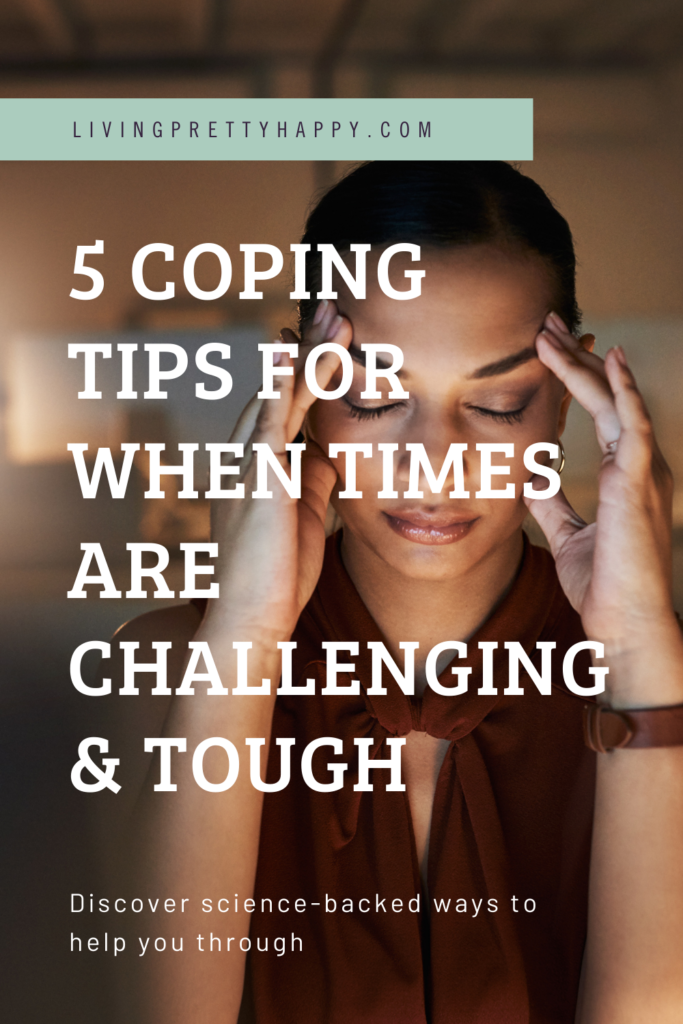
5 Coping tips for when times are challenging and tough
#01
Learn to ‘be’ with your emotions
OK, granted, when trying to ‘cope’ your first urge may be to suppress your feelings, however, acknowledging them is the best course of action. As humans, we experience a full range of emotions and it’s important to learn how to just be present with them. Laurie proffers the acronym RAIN to help you do just this…
Register – take a moment to realise your feelings, ‘oh, I’m feeling worried and apprehensive right now’
Accept – accept that you’re feeling whatever it is you’re feeling, you’re human not a robot.
Investigate – become curious about your feelings and their affect on you. How do they make your body feel? What happens to your breathing?
Nurture – rather than berate or judge yourself, practice some self-compassion. Think about how you would talk to a friend who feels as you currently do, what would you say to them? Extend this kindness to yourself.
#02
Exercise
Exercise, without a doubt, can bump up your well-being. One study claimed just 30 minutes of cardio had the same uplifting benefits as a dose of antidepressant medication. In fact, participants who kept up with the exercise (30-45 minutes 2-3 times per week) had significantly fewer relapses.
How much exercise do you need?
As adults it’s important to try to be physically active every day, remembering some activity is always better than no activity at all. We should aim to do at least 150 minutes of moderate-intensity activity a week or 75 minutes of vigorous-intensity activity a week. The NHS provides helpful guidance here.
Here’s a few recommended reads to help you establish your exercise habit:



#03
Gratitude
Simply writing (or reflecting) on 3-5 things you’re grateful for daily can help improve your wellbeing in 2 weeks. I’ve been doing this with my 9-year old daughter recently and it’s really helped to make a difference in how she feels.
Crucially, focusing on what we have to be grateful for enables us to apply a more balanced perspective increasing how positive and optimistic we feel. All of which raises our self-esteem and helps us feel happier.
Recommended gratitude-boosting reading:


#04
Be more social
Happy people tend to be more social people. Make sure to schedule regular social time. Whether that’s over the phone or in person, connecting with others can make you feel more supported, loved and provide a welcome distraction to lift your mood.
Top tip: Double-up on the happiness effect by combining your socialising with another coping strategy – why not exercise with a friend, or share with somebody why you’re feeling grateful.
How to become more sociable:



#05
Sleep
Creating positive sleep habits sets you up in the best way possible to cope when times are challenging and tough. Sleep is your body and brain’s opportunity to recharge and replenish. It’s as essential to our well-being as breathing, food and water.
A decent nights’ sleep can increase your focus, give you more energy, boost your immune system and improve your mood and emotional state. All the things you need when circumstances are hard.
Building better sleep habits:


Life can be tough, but so are you!
Unfortunately, there is no escaping tough & challenging times, but with these science-backed coping tips you’ll be better placed to handle whatever life hands to you, ready to welcome happier times ahead.
RELATED: 5 Things to try to help you feel less anxious
Additional Source References:
- https://www.happierhuman.com/the-science-of-gratitude/
- https://universityhealthnews.com/daily/depression/exercise-the-perfect-natural-antidepressant/
ADVERTISEMENT:


Some fab tips Alex – love the gratitude which I’m pleased to do, but also just started to do netball again and this is definitely a mood-booster! And now that we’re opening up again and can start socialising, let’s hope we can have more conversations …a problem shared is a problem halved as they say!
Absolutely Lauretta and great to hear about the netball too! Thanks for reading and sharing x
Very good tips especially during the current climate of our world.
Thank you and thank you for reading! x
Great post with so many useful tips. Thank you for sharing.
My pleasure! Thank you for reading x
Very helpful advice, thank you 😊
I’m so happy you found it helpful, thank you for reading xx
These are great and really practical tips, thanks Alex. Whenever I have a tough time, exercise is the one thing I try not to give up as although I may not feel like doing it, I know how much it helps me. I’ve found staying social more tricky over the past year (like many of us probably have) so I know I need to work on this for my wellbeing. I’ll call upon these tips next time I’m going through a rough patch. 🙂
Gemma x
Yes Gemma, I agree when we’re feeling low exercise is often the last thing we feel like doing but it always helps – at least that’s what I experience, I’m so glad you feel the same. Also, I bumped into a friend the other day and after saying hello to each other she looked at me a bit blankly, I asked if all was OK and she just said ‘I’m finding it hard to interact with people recently it’s like I’ve lost my ability to socialise’ and I could completely relate. We’re going out together soon to get back into the social swing of things again LOL but it’s an important readjustment to make for our well-being. Thanks so much for reading and sharing your thoughts xx