

There are seasons in life when everything feels a little heavier. Even small tasks can start to feel like big ones, and your usual coping strategies may not stretch as far as they normally do. If you’re feeling overwhelmed, there is nothing “wrong” with you — you’re simply human, responding to more than your system has capacity for at the moment.
Emotional resilience isn’t about being endlessly strong or unaffected. It’s about learning how to gently support yourself through challenging moments, so you can find your footing again with compassion rather than pressure.
Today, I’m sharing what emotional resilience really means, what makes overwhelm so common, and the small, research-informed shifts that can help you bounce back with kindness.

What Is Emotional Resilience?
Emotional resilience refers to your ability to adapt during difficult moments, recover from stress, and maintain a sense of grounding as you move through life. Research often describes resilience as a dynamic process — not a fixed trait. That means it can grow, soften, and strengthen over time.
Resilience isn’t about pushing through. It’s about supporting your inner capacity: the energy, clarity, and emotional space you need to function in a way that feels safe and manageable.
Why Overwhelm Happens (And Why It’s Not Your Fault)
Overwhelm is a natural response when your brain perceives more input than it can process. This might look like:
- A busy or unpredictable season
- Competing demands
- Emotional load from caring for others
- Living with chronic illness or limited energy
- A build-up of small stresses that never fully reset
Psychologists describe this as “cognitive overload” — when mental resources are stretched thin.
Overwhelm isn’t a personal failing. It’s simply your brain and nervous system signalling that you need more space, more support, or fewer demands.
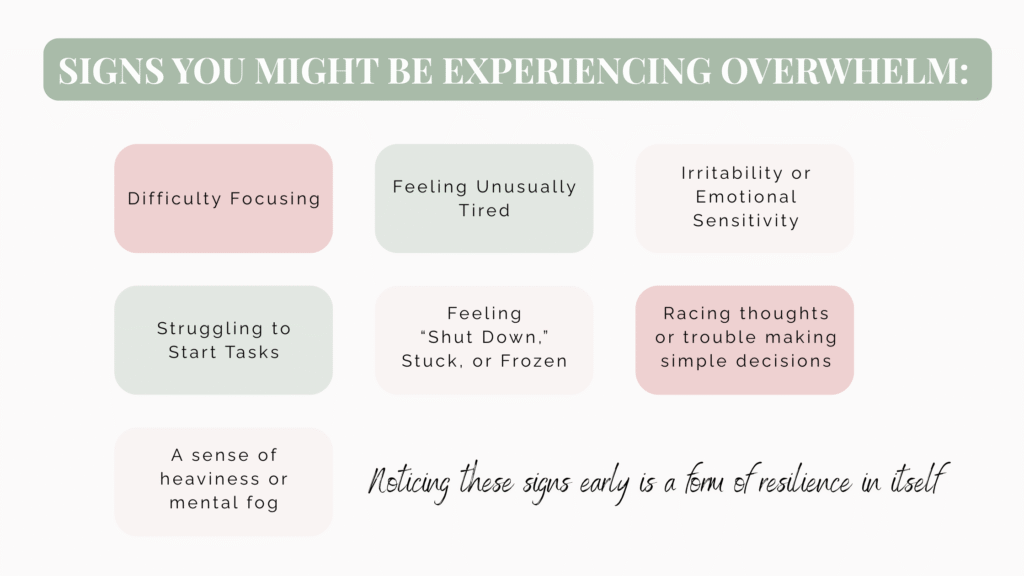
How to Build Emotional Resilience (Gently and Sustainably)
1. Start With Awareness, Not Action
When overwhelm sets in, many people instinctively try to do more to catch up. But research shows that pause and awareness support resilience better than immediate action.
Ask yourself:
- “What’s making things feel heavy right now?”
- “What’s one pressure I can soften?”
- “How is my body responding?”
This self-attunement helps reduce shame and reconnects you with clarity.
2. Create Micro-Moments of Emotional Safety
You don’t need huge lifestyle shifts to rebuild resilience — small, consistent cues of safety matter.

These micro-moments might include:
- Slowing your breathing
- A warm drink in your hands
- Reducing noise or visual clutter
- Grounding yourself by noticing your surroundings
- Speaking to yourself in a kind, steady tone
These gentle signals tell your nervous system, “We’re safe enough to soften.”
3. Make Tasks Smaller (Research Calls This “Chunking”)
When you’re overwhelmed, your brain benefits from smaller, clearer steps. Instead of “clean the kitchen,” try:
- “Clear a surface I can see.”
- “Wash five things.”
Chunking reduces cognitive load, making tasks more doable without pressure.
4. Protect Your Energy (Especially If You Live With Chronic Illness)
Energy-management research highlights the importance of pacing: alternating effort with rest to avoid depletion. This might look like:
- Setting realistic expectations
- Reducing commitments
- Using supportive tools like planners or trackers
- Listening to your body’s early signals
Resilience grows when you respect your limits — not when you push past them.

5. Connect With Supportive People (Even Briefly)
Connection, particularly with emotionally safe people, strengthens resilience. This could be a message, a check-in, or spending time with someone who doesn’t require you to “perform.” Shared emotional experience reduces the feeling of carrying everything alone.
6. Replenish Before You Expect Yourself to Perform
Many people unintentionally try to “bounce back” before they’ve had enough time or space to recover. Let yourself replenish — mentally, emotionally, energetically — before expecting full productivity. Recovery is progress.
Moving Forward With Compassion, Not Perfection
Resilience doesn’t mean you never feel overwhelmed. It means you meet yourself kindly during the harder parts — and trust that your capacity will return.
As you explore what supports you, remember: you don’t have to change everything at once. Small, compassionate steps consistently taken are enough.
Navigating overwhelm?
If you’re navigating overwhelm right now, I hope this reminded you that you’re not alone — and that there are supportive, sustainable ways to rebuild your emotional resilience.
I hope you’ve found my post on building emotional resilience helpful. What strategies do you think you’ll employ going forward to help you cope with overwhelm? What do you already do that helps? Please share your tips, they may help someone else reading this. As always, anything that you would like to say or ask, please do. I’m happy to help, and I always love to hear from you.
Source References:
- https://greatergood.berkeley.edu/article/item/what_actually_makes_you_resilient
- https://www.apa.org/topics/resilience/building-your-resilience
- https://www.nhs.uk/mental-health/feelings-symptoms-behaviours/feelings-and-symptoms/stress
- https://www.mind.org.uk/information-support/types-of-mental-health-problems/stress/managing-stress-and-building-resilience
- https://www.health.harvard.edu/staying-healthy/understanding-the-stress-response
- https://www.sciencedirect.com/science/article/pii/S1041608024000165
- https://www.healthline.com/health/depression/chronic-illness




I need this at the moment Alex, thank you so much. I always concentrate on my breathing during times of heightened stress and overwhelm. I slow my breathing and take longer out breaths. It’s something that can be done anywhere and I find it really does help to regulate my heart rate and make me feel calmer xx
Thanks so much for sharing, Fiona!