
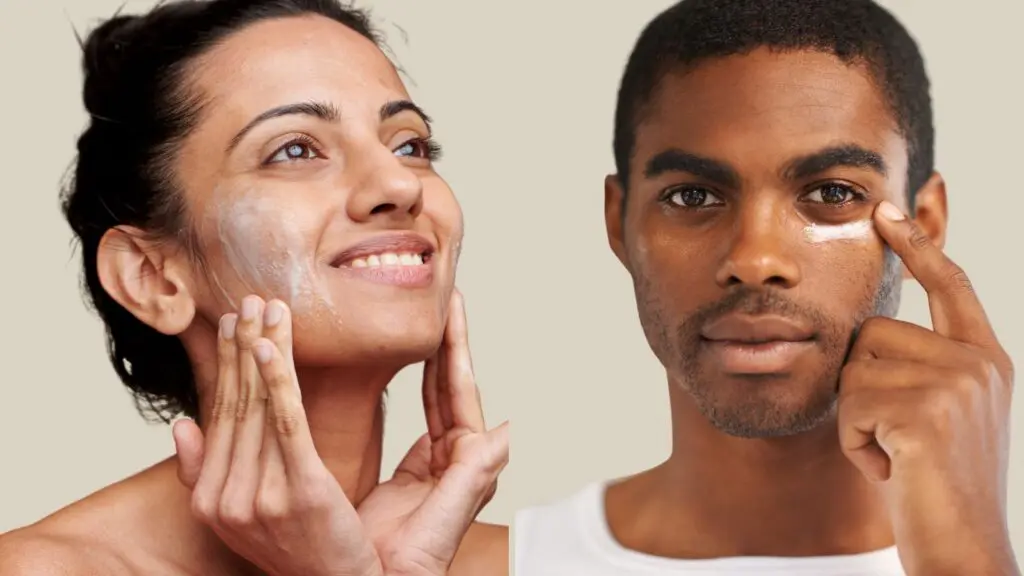
Today, I’m welcoming guest contributor Randa Zaid to share her skincare expertise and open an interesting conversation surrounding skincare products & gender. Over to you Randa…
The focus in any skincare routine should be the needs of your skin, not your gender.
Is your skin oily, dry, sensitive or a combination? Your gender doesn’t determine your skin type, and by specifying products this way, many people might miss out on optimising their skincare routines.
Men and women eat the same food, after all. They might prefer different flavours, and some might eat more than others, but many ingredients are the same and enjoyed by both. We don’t market food to feed male and female bodies differently, so why do we do it when it comes to feeding our skin?
Why are products currently marketed at different genders?

Gender sells.
Historic binary genderation goes back a long way, with many toys defining differences between the sexes: skipping ropes and dolls for girls; marbles and toy boats, trains, and cars for boys. Girls liking pink and boys liking blue is instinctual for most of us. This conditioning informs our thinking well into adulthood, and the cosmetics industry has, for some time, had the same mentality. It bought into the masculine versus feminine trope and used stereotypes as compelling marketing tools.
The colours in women’s products are soft and muted. The fragrance is flowery—roses, lilies, cotton and spring meadows—but men’s products are dark and smouldering, emphasising strength. The packaging is scattered with adjectives such as ice, glacier, shark and savage to ramp up the tough guy image. Strong, earthy smells are associated with masculinity, but shouldn’t it be up to individuals what type of smells they prefer?

GlobalData, which provides expert analysis for companies in the world’s biggest industries, reports that rising consumer expectations are driving the transition to gender-neutral products. Savvy retailers are already re-designing their stores to shift away from the traditional male and female sections.
Don’t buy into the hype.
Just because a product says, it is for women or men doesn’t mean both can’t use it. It might be marketed differently, but it doesn’t mean it’s not the same. In 2015 the New York City Department of Consumer Affairs found that women’s skincare products cost up to 13 per cent more than those marketed at men, and women tend to buy more skincare products than men.
Surely men’s and women’s skin are different?
Everyone’s skin is different. Men’s skin is around 20 – 25 per cent thicker than women’s. It contains more collagen and elastin and tends to produce more oil due to the amount of testosterone in the male body. This can make men more prone to breakouts. But women, too, have certain levels of this hormone; it’s not exclusive to men. Although some minor differences exist, they are not enough to warrant a gender-focused skincare industry.
There have been concerns in the past that male skin would be sensitised due to shaving, leading to products for men being branded as lighter. But it’s unnecessary to differentiate in this way, and these traditional views are rapidly disappearing. The American Academy of Dermatology has found no medical or scientific reason for products to be divided by gender. Products should be all about feeding the skin, regardless of gender. A product for oily skin is just that and can be used by both sexes for the same results.

Do it like an Egyptian.
Beauty held significant value in ancient Egypt, and the possession of an x or y chromosome had no bearing on the products they used for their self-care. Both men and women went to great lengths with their skincare routines with an emphasis on cleanliness. Taking care of the body was necessary for good health and warding off evil, and the same products were found in the graves of both men and women.
In modern society, we have tended to view self-care as being just for women, and many men haven’t wanted to be seen taking that sort of care for themselves. But that is changing. We must get away from the idea that taking care of our skin is about preventing wrinkles or focusing on anti-ageing. It’s not about vanity; it’s about nourishing our skin and taking care of ourselves. It’s less about gender and more about being holistic. Today’s men and women are more likely to be focused on greener, cleaner formulas than gender.
Choosing suitable products
Start with products that suit your skin type. Keep it simple. We don’t need hundreds of different products. Find a routine that works for you and stick with it. The days of husbands and boyfriends having to be coerced into using a face wash or moisturiser are diminishing in our enlightened world. Still, if men embrace a skincare routine for the first time, it makes sense to look for natural products. Don’t leap from never using skincare to suddenly slapping on something with a harsh retinol base.
The key ingredients to look out for are products with antioxidants and vitamins, especially A, C, D and E, and B12 for hydration. The fewer the ingredients, the better. A gentle cleanser with milk and honey or an olive oil soap won’t strip away the skin’s natural oils. A high-factor sunscreen in the morning should set you up for the day. Overnight an oil-based moisturiser will calm and nourish. And that is all anyone really needs, with perhaps a serum boost a couple of times a week for added hydration.

Randa Zaid is the founder of Hayaty Natural, a genderless skincare brand inspired by the wisdom of the ancient Egyptians. Using medicinal botanicals like Black Seed (so beloved by the Ancient Egyptians they called it the ‘blessed seed’) and a combination of plant-based ingredients sourced from local communities in Randa’s homelands of Egypt and Italy, each formulation follows ancient recipes developed by the Pharaohs to provide a holistic approach to self-care. Hayaty is Organic, Vegan, Fairtrade, Cruelty- and GMO-free. Packaged in recyclable glass and card, each bottle comes with a hand-made Egyptian papyrus to inspire us to love ourselves and our environment.
Facebook: https://www.facebook.com/hayatynatural
Instagram: https://www.instagram.com/hayatynatural/
TikTok: https://www.tiktok.com/@hayatynatural
LinkedIn: https://www.linkedin.com/in/randazaid/
RECOMMENDED: How to Get Started With Skincare – A No-Nonsense Guide to Looking After Your Skin
SOURCE REFERENCES:
- New York City Department of Consumer Affairs
- The American Academy of Dermatology
- Cosmetics Design Europe
- Beautystreams
- Globaldata
How do you feel about skincare products marketed to different genders? Do you like using skincare that is for your gender, or are you happy to try anything as long as it works? I’ve been using gender-neutral skincare brands for years now and I have been happy with the results – it’s more about the quality of the product and what it does for my skin, not my gender. How do you feel? Whatever you’d like to say – or ask – please do. Just leave me a comment in the box below. I’m happy to help, and I always love to hear from you!